
Please Login
Not Login
Register for MCA Entrance
Test Series
Syllabus
Free Resources
Achievements
Contact Us
About Us
Privacy Policy


Nimcet-2021
120 Questions • Previous Year Paper
NIMCET Papers
Question 1
+12-3
If y=tan−1(1−3x23x−x3),−31<x31 then dxdy is
A
−1+x21
B
1+x23
C
1+x23
D
1+x21
Question 2
+12-3
If e1=(1,1,1) and e2=(1,1,−1) and a and b are two vectors such that e1=2a+b and e2=a+2b, then the angle between a and b is
A
cos−1(−117)
B
cos−1(117)
C
cos−1(97)
D
cos−1(1162)
Question 3
+12-3
The probability that a man who is x years old will dies is p. Then, amongst n persons A1,A2,….,An each x years old now, the probability that A1 will die in one year is
A
n21
B
1−(1−p)n
C
n21[1−(1−p)n]
D
n1[1−(1−p)n]
Question 4
+12-3
If A={1,2,3,4} and B={3,4,5}, then the number of elements in (A∪B)×(A∩B)×(AΔB) is
A
18
B
20
C
24
D
30
Question 5
+12-3
For what value of p, the polynomial x4−3x3+2px2−6 is exactly divisible by (x-1)
A
2
B
4
C
6
D
8
Question 6
+12-3
Consider the following frequency distribution table
If the total frequency is 686 and the median is 42.6, then the value of f1 and f2 are

A
81, 25
B
82,24
C
83,23
D
84,22
Question 7
+12-3
In aΔABC if tan22A+tan22B+tan22C=k then k is always
A
>1
B
≥1
C
=2
D
=1
Question 8
+12-3
A polygon has 44 diagonals, the number of sides are
A
9
B
10
C
11
D
12
Question 9
+12-3
If n is an integer between 0 to 21, then find a value of n for which the value of n!(21−n)! is minimum
A
9
B
10
C
12
D
21
Question 10
+12-3
If ∣k∣=5and0∘≤θ≤360∘, then the number of different solutions of 3cosθ+4sinθ=k is
A
0
B
1
C
2
D
infinite
Question 11
+12-3
If y=sin−1(1+3x2+x4x2+1),x>0 then dxdy is
A
x4+3x2+1x2−1
B
x4+3x2+1x2+1
C
x4−3x2+1x2−1
D
x4−3x2+1x2+1
Question 12
+12-3
If the position vector of A and B relative to 0 be i^−4j^+3k^ and −i^+2j^−k^ respectively, then the median through O of ΔABC is
A
−2j^+2k^
B
−j^+k^
C
−i^−j^+k^
D
−i^−j^−k^
Question 13
+12-3
If log(1−x+x2)=a1x+a2x2+... then a3+a6+a9+... is
A
log2
B
32log2
C
31log2
D
2log2
Question 14
+12-3
The four geometric means between 2 and 64 are
A
1/4,1/8,1/16,1/32
B
4,8,16,32
C
42,8,162,32
D
NOT
Question 15
+12-3
If F(θ)=⎣⎡cosθsinθ0−sinθcosθ0001⎦⎤ then F(θ)F(α) is equal to
A
F(θα)
B
F(θ/α)
C
F(θ+α)
D
F(θ−α)
Question 16
+12-3
The standard deviation of 20 numbers is 30. If each of the numbers is increased by 4, the new standard deviation will be
A
24
B
34
C
30
D
20
Question 17
+12-3
The locus of the point of intersection of tangents to the ellipse a2x2+b2y2=1 which meet at right angle is
A
a circle
B
a parabola
C
an ellipse
D
hyperbola
Question 18
+12-3
∫333x33x3xdx is equal to
A
(log3)333x3x+c
B
(log3)33x+c
C
(log3)333x+c
D
(log3)3333x+c
Question 19
+12-3
If H1,H2,....,Hn are n harmonic means between a and b (=a) then H1−aH1+a+Hn−bHn+bis
A
2n
B
n+1
C
n-1
D
2n+1
Question 20
+12-3
In a triangle, if the sum of two sides is x and their product is y such that (x+z)(x-z)=y, where z is the third side of the triangle, then the triangle is
A
Equilateral
B
Right angled
C
Isosceles
D
Obtuse angled
Question 21
+12-3
If 32tan8θ=2cos2α−3cosα and3cos2θ=1, then the general value of αfor n∈Z is
A
nπ±3π
B
2nπ±32π
C
2nπ±3π
D
nπ±32π
Question 22
+12-3
If a variable takes values 0,1,2,..,50 with frequencies 1,50C1,50C2,....,50C50then the AM is
A
50
B
25
C
50250
D
51
Question 23
+12-3
The lines px+qy=1 and qx+py=1 are respectively the sides AB, AC of the triangle ABC and the base BC is bisected at (p,q). Equation of the median of the triangle through the vertex A is
A
(2pq−1)(qx+py−1)−(p2+q2−1)(px+qy−1)=0
B
(2pq−1)(px+qy−1)+(p2+q2−1)(qx+py−1)=0
C
(2pq−1)(px+qy−1)−(p2+q2−1)(qx+py−1)=0
D
(2pq−1)(qx+py−1)+(p2+q2−1)(px+qy−1)=0
Question 24
+12-3
Angle between a and b is 120∘. If ∣b∣=2∣a∣ and the vectors a+xb,a−bare at right angles, then x is
A
31
B
51
C
32
D
52
Question 25
+12-3
If α=β and α2=5α−3,β2=5β−3, then the equation whose roots are βα and αβ is
A
3x2−25x+3=0
B
3x2+5x+3=0
C
3x2−5x+3=0
D
3x2−19x+3=0
Question 26
+12-3
The general value of θ, satisfying sinθ=−21,tanθ=31 is
A
nπ+6π,n∈I
B
nπ+(−1)n67π,n∈I
C
2nπ±67π,n∈I
D
2nπ+611π,n∈I
Question 27
+12-3
If acosθ+bsinθ=2 and asinθ−bcosθ=3 then a2+b2 is
A
6
B
5
C
13
D
10
Question 28
+12-3
If the system of equations 3x−y+4z=3, x+2y−3z=−2, 6x+5y+λz=−3 has at least one solution then λ is
\end{enumerate}
A
-5
B
3
C
5
D
6
Question 29
+12-3
There are 50 questions in a paper. Find the number of ways in which a student can attempt one or more questions
A
250−1
B
250+1
C
250−2
D
250+2
Question 30
+12-3
The function f(x)=1+xtanxx,0≤x≤2π is maximum when
A
x=secx
B
x=tanx
C
x=cosx
D
NOT
Question 31
+12-3
If P(1,2), Q(4,6), R(5,7) and S(a,b) are the vertices of a parallelogram PQRS then
A
a=2, b=3
B
a=3, b=4
C
a=2, b=4
D
a=3, b=5
Question 32
+12-3
x→∞lim(x+2x+7)x+5equals to
A
e5
B
e−5
C
e2
D
e−2
Question 33
+12-3
If in the triangle ABC acos22C+ccos22A=23b then the sides of the triangle are in
A
AP
B
GP
C
HP
D
NOT
Question 34
+12-3
If 2!(n−2)!n! and 4!(n−4)!n! are in the ratio 2:1, then the value of n is
A
0
B
2
C
4
D
5
Question 35
+12-3
The eccentric angles of the extremities of latus-recta of the ellipse a2x2+b2y2=1 are given by
A
tan−1(±bae)
B
tan−1(±bbe)
C
tan−1(±aeb)
D
tan−1(±bea)
Question 36
+12-3
Let a=i^+j^ and b=2i^−k^. Then, the point of intersection of the lines r×a=b×a and r×b=a×b is
A
−i^+j^+k^
B
3i^−j^+k^
C
i^−j^−k^
D
3i^+j^−k^
Question 37
+12-3
If f:R→R is defined by f(x)=⎩⎨⎧x2+3x+2x+2,x∈R−{−1,−2}−1,x=−20,x=−1 then f(x) is continuous on the set
A
R
B
R-{-2}
C
R-{-1}
D
R-{-1,-2}
Question 38
+12-3
If θis the acute angle between the pair of lines x2−7xy+12y2=0 then 4sinθ+5cosθ2cosθ+3sinθ is
A
6929
B
3961
C
6139
D
2969
Question 39
+12-3
The area of the triangle formed by the vertices whose position vectors are 3i^+j^, 5i^+2j^+k^, i^−2j^+3k^ is
A
21
B
23
C
33
D
29
Question 40
+12-3
∫ex(sinhx+coshx)dx is
A
exsechx+c
B
excoshx+c
C
sinh2x+c
D
cosh2x+c
Question 41
+12-3
Let a=2i^+j^+2k^, b=i^−j^+2k^ and c=i^+j^−2k^are three vectors. Then, a vector in the plane of aand cwhose projection on bis of magnitude 61 is
A
3i^−2j^
B
3i^+2j^
C
2i^+3j^−k^
D
3i^+2j^+k^
Question 42
+12-3
If a number x is selected from natural numbers 1,2,..,100, then the probability for x+x100>29 is
A
5037
B
5039
C
5041
D
5043
Question 43
+12-3
The value of tan9∘−tan27∘−tan63∘+tan81∘ is equal to
A
5
B
3
C
4
D
6
Question 44
+12-3
If the vectors ai^+j^+k^, i^+bj^+k^, i^+j^+ck^ (a,b,c=1) are coplanar, then 1−a1+1−b1+1−c1 is
A
0
B
1
C
2
D
3
Question 45
+12-3
The number of common tangents to the circle x2+y2=4 and x2+y2−6x−8y = 24 is
A
0
B
1
C
2
D
4
Question 46
+12-3
In three throws of three dice, the probability of throwing triplets not more than twice is
A
1−621
B
1−631
C
1−3621
D
1−3631
Question 47
+12-3
The probability of occurrence of two events E and F are 0.25 and 0.50, respectively. The probability of their simultaneous occurrence is 0.14. The probability that neither E nor F occurs is
A
0.61
B
0.11
C
0.39
D
0.89
Question 48
+12-3
If X and Y are two sets, then X∩Y′∩(X∪Y)′ is
A
X′
B
Y′
C
ϕ
D
NOT
Question 49
+12-3
The area of the region bounded by the x-axis and the curves defined by y=tanx,−3π≤x≤3π and y=cotx,6π≤x≤23π is
A
−21log2
B
21log2
C
log2
D
NOT
Question 50
+12-3
Suppose that A1,A2,….A30 are 30 sets each having 5 elements and B1,B2,….Bn sets each with 3 elements such that ⋃i=130Ai=⋃j=1nBj=S. If each element of S belongs to exactly ten of the Ai's and exactly nine of the Bj's, then n is
A
15
B
45
C
75
D
90
Question 51
+6-1.5
Choose the pair of number that comes next :
1, 10, 7, 20, 13, 30, 19, ?,?
A
40,25
B
26,24
C
26, 23
D
25, 23
Question 52
+6-1.5
Which word does NOT belong with the others?
A
Wing
B
fin
C
beak
D
rudder
Question 53
+6-1.5
Choose the missing term: BYCX: DWEV::FUGT:?
A
EHIJ
B
GHIJ
C
HSIR
D
SRHS
Question 54
+6-1.5
If Z=52 and ACT=48, then BAT will be
A
46
B
39
C
44
D
41
Question 55
+6-1.5
Choose the odd one:
A
Zebra
B
Hyena
C
Rhinoceros
D
Giraffe
Question 56
+6-1.5
There are six members in a family. A is the father of D, E is the grandfather of D. B is the daughter in law of C. F is the uncle of D. what is the relationship of C with F?
A
Sister
B
Mother in law
C
Nephew
D
NOT
Question 57
+6-1.5
Radha is twice as old as Rita was 2 years ago. If difference between their ages is 2 years, how old is Radha today?
A
6
B
8
C
10
D
12
Question 58
+6-1.5
Choose the word which has the same relationship among the given three words:
Yellow, Blue, Red
A
Black
B
Orange
C
white
D
Paint
Question 59
+6-1.5
COUNSEL is to BITIRAK, so also GUIDANCE is to__?
A
EOHYZKBB
B
FOHYZIBB
C
FPHZZKAB
D
HOHYBJBA
Question 60
+6-1.5
Choose the pair that best represents a similar relationship to the one expressed in the original pair of words: PULSATE: THROB
A
Walk: Run
B
Tired: Sleep
C
Examine: Scrutinize
D
Ballet: Dancer
Question 61
+6-1.5
If 9×3+8=24,10×2+7=35 and 80×40+3=6, then find the value of 12×4+3=?
A
7
B
9
C
12
D
16
Question 62
+6-1.5
Choose the pair that best represents a similar relationship to the one expressed in the original pair of words: WAITRESS: RESTAURANT
A
Doctor: Diagnosis
B
actor: role
C
Driver: truck
D
teacher : school
Question 63
+6-1.5
Insert the missing number 8,7,11,12,14,17,17,22,?
A
27
B
20
C
22
D
24
Question 64
+6-1.5
How many times in a day are the hands of a clock pointing opposite to each other?
A
4
B
20
C
22
D
24
Question 65
+6-1.5
Choose the number pair or group that is different from others?
A
15:46
B
12:37
C
9:28
D
8:33
Question 66
+6-1.5
Choose the word that is a necessary part of the underlined word: harvest
A
Autumn
B
crop
C
stockpile
D
tractor
Question 67
+6-1.5
If it is known that at least 23 students were eligible for a Symposium on Chemistry, the minimum qualifying marks in Chemistry for eligibility to Symposium would lie in the range
A
30-40
B
20-30
C
Below 20
D
NOT
Question 68
+6-1.5
Study the following table carefully and answer the following question.
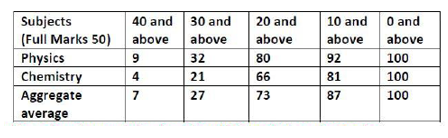
Question:What is the difference between the number of students passed with 30 as cut off marks in Chemistry and those passed with 30 as cut off in aggregate?
A
3
B
4
C
5
D
6
Question 69
+6-1.5
Study the following table carefully and answer the following question.
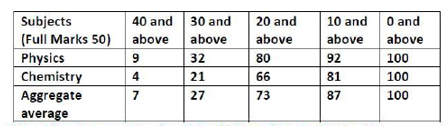
Question:If at least 60% marks in Physics are required for pursuing higher studies in Physics, how many students will be eligible to pursue higher studies in Physics?
A
27
B
32
C
34
D
41
Question 70
+6-1.5
Study the following table carefully and answer the following question.
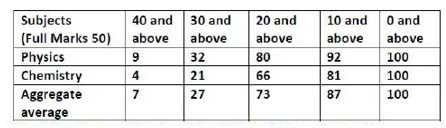
Question:The number of students scoring less than 40% marks in aggregate is
A
13
B
19
C
20
D
27
Question 71
+6-1.5
Choose the missing term out of the given alternatives: Q1F,S2E,U6D,W21C, ?
A
Y66B
B
Y44B
C
Y88B
D
Z88B
Question 72
+6-1.5
In a certain code language, `do re me' means `he is late'; `fa me la' means `she is early' and `so ti do' means `he leaves soon'. Which would in the languages means `late'?
A
la
B
do
C
me
D
re
Question 73
+6-1.5
Find the matching term for
Music: Guitar:Performer
A
Dance:Tune:Instrument
B
Food: Recipe:Cook
C
Patient: Medicine:doctor
D
Trick:Rope:Acrobat
Question 74
+6-1.5
What is C to A?
A
Daughter
B
Grad mother
C
Mother
D
Cannot be determined
Question 75
+6-1.5
How many male members are there in the family?
A
3
B
2
C
cannot be determined
D
NOT
Question 76
+6-1.5
Who among the following is one of the couples?
A
CD
B
DE
C
EB
D
NOT
Question 77
+6-1.5
Read the information given below and answer the following question:
i. In a family of six persons A,B,C,D,E and F, there are two married couples.
ii. D is grandmother of A and mother of B.
iii. C is wife of B and mother of F.
iv. F is the granddaughter of E.
which of the following is true?
A
A is brother of F
B
A is sister of F
C
D has two grandsons
D
NOT
Question 78
+6-1.5
Find the missing term 7:56::9:?
A
63
B
81
C
90
D
99
Question 79
+6-1.5
Choose the correct option for the remainder when x=1!+2!+……+100! Is divided by 24
A
9
B
11
C
152
D
13
Question 80
+6-1.5
If it is Saturday on January 1,2000, then January 1, 2001 would have been
A
Monday
B
Sunday
C
Tuesday
D
Friday
Question 81
+6-1.5
i. PψQ means P is mother of Q
ii. P∈Q means P is sister of Q
iii. P\\) Q$ means P is father of Q
\(\newline iv. P#Q means P is brother of Q
Question:Which of the following means R is brother of T?
A
\(R\psi S\# U\\) T$
B
UψR#S#T
C
UψR∈SψT
D
\(T\# S\\) Q\in R$
Question 82
+6-1.5
i. PψQ means P is mother of Q
ii. P∈Q means P is sister of Q
iii. P\\) Q$ means P is father of Q
\(\newline iv. P#Q means P is brother of Q
Question: If KψL∈M#N, then how K is related with N?
A
Mother
B
Aunt
C
Great Aunt
D
Grad mother
Question 83
+6-1.5
Read the following information carefully and then answer the following question:
i. PψQ means P is mother of Q
ii. P∈Q means P is sister of Q
iii. P\\) Q$ means P is father of Q
\(\newline iv. P#Q means P is brother of Q
Question: which of the following means N is definitely daughter of K?
A
K\$L\#M\#N
B
\(M\psi K\\) N\in L$
C
KψM#L∈N
D
\(L\psi K\\) N\# M$
Question 84
+6-1.5
Insert the missing number: 16,33,65,131, 261,?
A
523
B
521
C
613
D
721
Question 85
+6-1.5
In this series, looking at the letter pattern fill the blank in the middle of the series:
ELFA, GLHA, ILJA,___, MLNA
A
OLPA
B
KLMA
C
LLMA
D
KLLA
Question 86
+6-1.5
In a class of 50 students, Raghu's rank is twice that of Paul. There are 10 students who have ranked worse than that of Raghu. Paul's rank in the class is
A
5th
B
10th
C
15th
D
20th
Question 87
+6-1.5
If `A3T15R' stands for `ACTOR' and `D1T5' stands for `DATE', how will you code `ROTATE'
A
R16T1T5
B
R15T1T5
C
R15T1T16
D
R15C1&7
Question 88
+6-1.5
A company produces five different products. The sales of these five products (in lakh number of packs) during 2005 and 2010 are shown in the following bar graph.
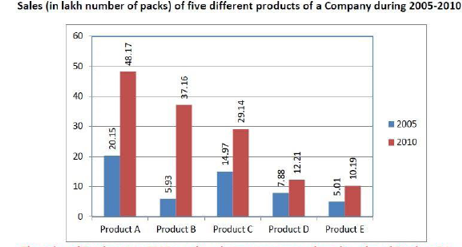
Question:During the period 2005-2010, the minimum rate of increase in sales is in the case of Product
A
A
B
B
C
C
D
D
Question 89
+6-1.5
A company produces five different products. The sales of these five products (in lakh number of packs) during 2005 and 2010 are shown in the following bar graph.
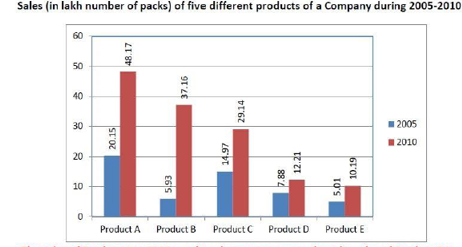
Question:The sales have increased by nearly 55% from 2005 to 2010 in case of Product
A
A
B
B
C
C
D
D
Question 90
+6-1.5
A company produces five different products. The sales of these five products (in lakh number of packs) during 2005 and 2010 are shown in the following bar graph.
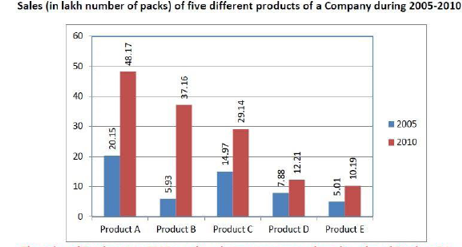
Question:The sales of Product A in 2010 was by what percent more than the sales of Product B in 2010? (Rounded off to the nearest Integer.)
A
33%
B
31%
C
28%
D
22%
Question 91
+8-2
Which of the following is used by ALU to store the intermediate results?
A
Stack
B
Heap
C
Registers
D
Accumulators
Question 92
+8-2
To access the I/O devices the status flags is continuously checked in
A
Program controlled I/O
B
Memory mapped I/O
C
I/O mapped
D
NOT
Question 93
+8-2
The binary multiplication 00*11 will give
A
11
B
00
C
01
D
10
Question 94
+8-2
To fetch data from the secondary memory which one of the following register is used
A
MAR
B
PC
C
IR
D
MBR
Question 95
+8-2
The cache memory is more effective because of
A
Memory localization
B
Locality of reference
C
Memory size
D
NOT
Question 96
+8-2
Consider a computer system with speed of 106 instructions per second. A program P, having 2n2 steps is run on this system, where n is the input size. If n=10000, what is the execution time for P?
A
2 sec
B
20 sec
C
100 sec
D
200 sec
Question 97
+8-2
One TeraByte (TB)=_____ GB and One ExaByte(EB)=______ GB
A
210, 216
B
210, 220
C
210, 224
D
210, 230
Question 98
+8-2
The process when processor fetch or decode another instruction during the execution of current instruction is called
A
Supercomputing
B
pipelining
C
Cloud computing
D
Grid computing
Question 99
+8-2
Which of the following is the fastest means of memory access of CPU?
A
Registers
B
Cache
C
Main memory
D
Stack
Question 100
+8-2
The number (2217)8 is equivalent to
A
(608)16
B
(028F)16
C
(048f)16
D
(2297)16
Question 101
+4-1
Choose the most suitable antonym of the given word: ERUDITE
A
Scholarly
B
unfamiliar
C
Illiterate
D
arrogant
Question 102
+4-1
Write one word for the following:
An uncivilized/primitive person.
A
Barbarian
B
ascetic
C
Bourgeois
D
altruist
Question 103
+4-1
Fill in the blank with the most appropriate word given:
I cannot ___it to your right now; tomorrow we will discuss about it.
A
Demand
B
disturb
C
explain
D
expect
Question 104
+4-1
Write one word for the following:
One who does not save for future.
A
Incorporeal
B
inedible
C
Improvident
D
implacable
Question 105
+4-1
Choose the most suitable synonym of the given word: SCINTILLATING
A
Touching
B
nagging
C
Glittering
D
warning
Question 106
+4-1
Fill in the blank with the most appropriate word: The car driver was arrested for rash driving and his license was ____ by the police.
A
Impounded
B
flown
C
Penalized
D
banned
Question 107
+4-1
Choose the most suitable synonym of the given word: RECUPERATE
A
recapture
B
reclaim
C
recover
D
recur
Question 108
+4-1
Choose the most suitable antonym of the given word: NEGLIGENCE
A
Diligence
B
meticulousness
C
Integrity
D
honesty
Question 109
+4-1
Fill in the blank with the most appropriate word: The ___ with which he is able to wield the paint brush is really remarkable.
A
ease
B
practice
C
sweep
D
gait
Question 110
+4-1
Fill in the blank with the most appropriate word given in the options
The child prefers rooms with____ ceilings.
A
tall
B
long
C
higher
D
high
Question 111
+4-1
Choose the most suitable synonym of the given word: BLAND
A
Pleasant
B
harsh
C
irritating
D
tasteless
Question 112
+4-1
Fill in the blank with the most appropriate word given:
The state transportation corporation has ____ a loss of 5 core INR this year.
A
derived
B
incurred
C
performed
D
formulated
Question 113
+4-1
It is said with truth that the function of a university is to prepare the young to take their place in human society. It must provide Its members with the knowledge and skill necessary to make them efficient citizens. But is the whole duty of man exhausted by the acquisition of knowledge and professional training? Is a university only an institution or higher learning, a fact my which churns out clerks and technicians able to run the machinery of the State? Mere knowledge which gratifies curiosity is different from culture which refines personality. Culture is not rernembe1ing a mass of se1ious detains about the dates of birth of the great heroes of the world or the interesting names of the fastest ships which cross the Atlantic or entertaining odds and ends gathered from the latest who's who. A well-known institution of this country has for Its motto\textbf{ sa vidya yavimuchyate}: that is, knowledge which is designed for salvation, for the development of the soul, is the best. Such an idea is not merely an Indian idiosyncrasy. Plato said long ago that the culture of soul is "the first and fairest thing that the best of men can ever have. According to Goethe, the object of education is to form tastes and not simply to communicate knowledge. A man's culture Is not judged by the amount of tabulated information which he has at his command, but by the quality of mind which he b1ings to bear on the facts of life. Education is not cramming the mind with a host of technical details, putting sight, as it were, into blind eyes. The eye of the soul Is never blind, only its gaze may be turned to the false and the fleeting. Too often the vision may be dragged downwards by the "leaden weights" of pride and prejudice, of passion and desire. The function of the teacher is not to add to the "leaden weights" but remove them and liberate the soul from the encumbrance so that it may follow its native impulse to soar upwards. The student at a university does not merely learn something, but becomes something by being exposed, in the most elastic pe1iod of his life, to transforming influences, such as the constant clash of mind with mind, the interchange of ideas, the testing of opinions, and the growth of knowledge of human nature.
Question:Mere knowledge and culture may be distinguished from each other in that
A
The former widens the mental horizon, the latter enlarges the heart
B
The former gratifies curiosity, the latter refines personality
C
The former is concerned with facts, the latter with fiction
D
The former adds to power, the latter adds to prestige
Question 114
+4-1
It is said with truth that the function of a university is to prepare the young to take their place in human society. It must provide Its members with the knowledge and skill necessary to make them efficient citizens. But is the whole duty of man exhausted by the acquisition of knowledge and professional training? Is a university only an institution or higher learning, a fact my which churns out clerks and technicians able to run the machinery of the State? Mere knowledge which gratifies curiosity is different from culture which refines personality. Culture is not rernembe1ing a mass of se1ious detains about the dates of birth of the great heroes of the world or the interesting names of the fastest ships which cross the Atlantic or entertaining odds and ends gathered from the latest who's who. A well-known institution of this country has for Its motto\textbf{ sa vidya yavimuchyate}: that is, knowledge which is designed for salvation, for the development of the soul, is the best. Such an idea is not merely an Indian idiosyncrasy. Plato said long ago that the culture of soul is "the first and fairest thing that the best of men can ever have. According to Goethe, the object of education is to form tastes and not simply to communicate knowledge. A man's culture Is not judged by the amount of tabulated information which he has at his command, but by the quality of mind which he b1ings to bear on the facts of life. Education is not cramming the mind with a host of technical details, putting sight, as it were, into blind eyes. The eye of the soul Is never blind, only its gaze may be turned to the false and the fleeting. Too often the vision may be dragged downwards by the "leaden weights" of pride and prejudice, of passion and desire. The function of the teacher is not to add to the "leaden weights" but remove them and liberate the soul from the encumbrance so that it may follow its native impulse to soar upwards. The student at a university does not merely learn something, but becomes something by being exposed, in the most elastic pe1iod of his life, to transforming influences, such as the constant clash of mind with mind, the interchange of ideas, the testing of opinions, and the growth of knowledge of human nature.
Question: What is meant by ``leaden weights''
A
Weights made of leaden
B
Cold scientific knowledge
C
Hindering factors, of pride and prejudice, passion and desire, in the liberation of the soul
D
Social and family responsibilities
Question 115
+4-1
It is said with truth that the function of a university is to prepare the young to take their place in human society. It must provide Its members with the knowledge and skill necessary to make them efficient citizens. But is the whole duty of man exhausted by the acquisition of knowledge and professional training? Is a university only an institution or higher learning, a fact my which churns out clerks and technicians able to run the machinery of the State? Mere knowledge which gratifies curiosity is different from culture which refines personality. Culture is not rernembe1ing a mass of se1ious detains about the dates of birth of the great heroes of the world or the interesting names of the fastest ships which cross the Atlantic or entertaining odds and ends gathered from the latest who's who. A well-known institution of this country has for Its motto\textbf{ sa vidya yavimuchyate}: that is, knowledge which is designed for salvation, for the development of the soul, is the best. Such an idea is not merely an Indian idiosyncrasy. Plato said long ago that the culture of soul is "the first and fairest thing that the best of men can ever have. According to Goethe, the object of education is to form tastes and not simply to communicate knowledge. A man's culture Is not judged by the amount of tabulated information which he has at his command, but by the quality of mind which he b1ings to bear on the facts of life. Education is not cramming the mind with a host of technical details, putting sight, as it were, into blind eyes. The eye of the soul Is never blind, only its gaze may be turned to the false and the fleeting. Too often the vision may be dragged downwards by the "leaden weights" of pride and prejudice, of passion and desire. The function of the teacher is not to add to the "leaden weights" but remove them and liberate the soul from the encumbrance so that it may follow its native impulse to soar upwards. The student at a university does not merely learn something, but becomes something by being exposed, in the most elastic pe1iod of his life, to transforming influences, such as the constant clash of mind with mind, the interchange of ideas, the testing of opinions, and the growth of knowledge of human nature.
Question:According to the passage, the function of the teacher is
A
To remove leaden weights of pride and prejudice, passion, and desire to liberate the soul
B
To install facts into the minds of the students
C
To teach humanity
D
To foster brotherhood
Question 116
+4-1
It is said with truth that the function of a university is to prepare the young to take their place in human society. It must provide Its members with the knowledge and skill necessary to make them efficient citizens. But is the whole duty of man exhausted by the acquisition of knowledge and professional training? Is a university only an institution or higher learning, a fact my which churns out clerks and technicians able to run the machinery of the State? Mere knowledge which gratifies curiosity is different from culture which refines personality. Culture is not rernembe1ing a mass of se1ious detains about the dates of birth of the great heroes of the world or the interesting names of the fastest ships which cross the Atlantic or entertaining odds and ends gathered from the latest who's who. A well-known institution of this country has for Its motto\textbf{ sa vidya yavimuchyate}: that is, knowledge which is designed for salvation, for the development of the soul, is the best. Such an idea is not merely an Indian idiosyncrasy. Plato said long ago that the culture of soul is "the first and fairest thing that the best of men can ever have. According to Goethe, the object of education is to form tastes and not simply to communicate knowledge. A man's culture Is not judged by the amount of tabulated information which he has at his command, but by the quality of mind which he b1ings to bear on the facts of life. Education is not cramming the mind with a host of technical details, putting sight, as it were, into blind eyes. The eye of the soul Is never blind, only its gaze may be turned to the false and the fleeting. Too often the vision may be dragged downwards by the "leaden weights" of pride and prejudice, of passion and desire. The function of the teacher is not to add to the "leaden weights" but remove them and liberate the soul from the encumbrance so that it may follow its native impulse to soar upwards. The student at a university does not merely learn something, but becomes something by being exposed, in the most elastic pe1iod of his life, to transforming influences, such as the constant clash of mind with mind, the interchange of ideas, the testing of opinions, and the growth of knowledge of human nature.
Question:What is the function of education according to the ancient Indian philosophers?
A
Education is the development of mind
B
Education brings about salvation and development of the soul
C
Education is the cultivation of culture
D
Education aims at the inculcation of generosity
Question 117
+4-1
It is said with truth that the function of a university is to prepare the young to take their place in human society. It must provide Its members with the knowledge and skill necessary to make them efficient citizens. But is the whole duty of man exhausted by the acquisition of knowledge and professional training? Is a university only an institution or higher learning, a fact my which churns out clerks and technicians able to run the machinery of the State? Mere knowledge which gratifies curiosity is different from culture which refines personality. Culture is not rernembe1ing a mass of se1ious detains about the dates of birth of the great heroes of the world or the interesting names of the fastest ships which cross the Atlantic or entertaining odds and ends gathered from the latest who's who. A well-known institution of this country has for Its motto\textbf{ sa vidya yavimuchyate}: that is, knowledge which is designed for salvation, for the development of the soul, is the best. Such an idea is not merely an Indian idiosyncrasy. Plato said long ago that the culture of soul is "the first and fairest thing that the best of men can ever have. According to Goethe, the object of education is to form tastes and not simply to communicate knowledge. A man's culture Is not judged by the amount of tabulated information which he has at his command, but by the quality of mind which he b1ings to bear on the facts of life. Education is not cramming the mind with a host of technical details, putting sight, as it were, into blind eyes. The eye of the soul Is never blind, only its gaze may be turned to the false and the fleeting. Too often the vision may be dragged downwards by the "leaden weights" of pride and prejudice, of passion and desire. The function of the teacher is not to add to the "leaden weights" but remove them and liberate the soul from the encumbrance so that it may follow its native impulse to soar upwards. The student at a university does not merely learn something, but becomes something by being exposed, in the most elastic pe1iod of his life, to transforming influences, such as the constant clash of mind with mind, the interchange of ideas, the testing of opinions, and the growth of knowledge of human nature.
Question:The function of university is
A
To enable the young to gather facts about the world
B
To learn to do his job
C
To prepare the young to take their place in society
D
To enable them to learn to talk with others
Question 118
+4-1
It is said with truth that the function of a university is to prepare the young to take their place in human society. It must provide Its members with the knowledge and skill necessary to make them efficient citizens. But is the whole duty of man exhausted by the acquisition of knowledge and professional training? Is a university only an institution or higher learning, a fact my which churns out clerks and technicians able to run the machinery of the State? Mere knowledge which gratifies curiosity is different from culture which refines personality. Culture is not rernembe1ing a mass of se1ious detains about the dates of birth of the great heroes of the world or the interesting names of the fastest ships which cross the Atlantic or entertaining odds and ends gathered from the latest who's who. A well-known institution of this country has for Its motto\textbf{ sa vidya yavimuchyate}: that is, knowledge which is designed for salvation, for the development of the soul, is the best. Such an idea is not merely an Indian idiosyncrasy. Plato said long ago that the culture of soul is "the first and fairest thing that the best of men can ever have. According to Goethe, the object of education is to form tastes and not simply to communicate knowledge. A man's culture Is not judged by the amount of tabulated information which he has at his command, but by the quality of mind which he b1ings to bear on the facts of life. Education is not cramming the mind with a host of technical details, putting sight, as it were, into blind eyes. The eye of the soul Is never blind, only its gaze may be turned to the false and the fleeting. Too often the vision may be dragged downwards by the "leaden weights" of pride and prejudice, of passion and desire. The function of the teacher is not to add to the "leaden weights" but remove them and liberate the soul from the encumbrance so that it may follow its native impulse to soar upwards. The student at a university does not merely learn something, but becomes something by being exposed, in the most elastic pe1iod of his life, to transforming influences, such as the constant clash of mind with mind, the interchange of ideas, the testing of opinions, and the growth of knowledge of human nature.
Question:What are the hindering factors in the liberation and development of soul?
A
Power and wealth
B
Passion and desire, pride and prejudice
C
Money and influence
D
Greed and evny
Question 119
+4-1
It is said with truth that the function of a university is to prepare the young to take their place in human society. It must provide Its members with the knowledge and skill necessary to make them efficient citizens. But is the whole duty of man exhausted by the acquisition of knowledge and professional training? Is a university only an institution or higher learning, a fact my which churns out clerks and technicians able to run the machinery of the State? Mere knowledge which gratifies curiosity is different from culture which refines personality. Culture is not rernembe1ing a mass of se1ious detains about the dates of birth of the great heroes of the world or the interesting names of the fastest ships which cross the Atlantic or entertaining odds and ends gathered from the latest who's who. A well-known institution of this country has for Its motto\textbf{ sa vidya yavimuchyate}: that is, knowledge which is designed for salvation, for the development of the soul, is the best. Such an idea is not merely an Indian idiosyncrasy. Plato said long ago that the culture of soul is "the first and fairest thing that the best of men can ever have. According to Goethe, the object of education is to form tastes and not simply to communicate knowledge. A man's culture Is not judged by the amount of tabulated information which he has at his command, but by the quality of mind which he b1ings to bear on the facts of life. Education is not cramming the mind with a host of technical details, putting sight, as it were, into blind eyes. The eye of the soul Is never blind, only its gaze may be turned to the false and the fleeting. Too often the vision may be dragged downwards by the "leaden weights" of pride and prejudice, of passion and desire. The function of the teacher is not to add to the "leaden weights" but remove them and liberate the soul from the encumbrance so that it may follow its native impulse to soar upwards. The student at a university does not merely learn something, but becomes something by being exposed, in the most elastic pe1iod of his life, to transforming influences, such as the constant clash of mind with mind, the interchange of ideas, the testing of opinions, and the growth of knowledge of human nature.
Question: What is the object of education according to Goethe?
A
It teaches social manners
B
It teaches courtesy
C
It communicates knowledge
D
It forms taste
Question 120
+4-1
Read the following passage carefully and answer the question that follow:
It is said with truth that the function of a university is to prepare the young to take their place in human society. It must provide Its members with the knowledge and skill necessary to make them efficient citizens. But is the whole duty of man exhausted by the acquisition of knowledge and professional training? Is a university only an institution or higher learning, a fact my which churns out clerks and technicians able to run the machinery of the State? Mere knowledge which gratifies curiosity is different from culture which refines personality. Culture is not rernembe1ing a mass of se1ious detains about the dates of birth of the great heroes of the world or the interesting names of the fastest ships which cross the Atlantic or entertaining odds and ends gathered from the latest who's who. A well-known institution of this country has for Its motto\textbf{ sa vidya yavimuchyate}: that is, knowledge which is designed for salvation, for the development of the soul, is the best. Such an idea is not merely an Indian idiosyncrasy. Plato said long ago that the culture of soul is "the first and fairest thing that the best of men can ever have. According to Goethe, the object of education is to form tastes and not simply to communicate knowledge. A man's culture Is not judged by the amount of tabulated information which he has at his command, but by the quality of mind which he b1ings to bear on the facts of life. Education is not cramming the mind with a host of technical details, putting sight, as it were, into blind eyes. The eye of the soul Is never blind, only its gaze may be turned to the false and the fleeting. Too often the vision may be dragged downwards by the "leaden weights" of pride and prejudice, of passion and desire. The function of the teacher is not to add to the "leaden weights" but remove them and liberate the soul from the encumbrance so that it may follow its native impulse to soar upwards. The student at a university does not merely learn something, but becomes something by being exposed, in the most elastic pe1iod of his life, to transforming influences, such as the constant clash of mind with mind, the interchange of ideas, the testing of opinions, and the growth of knowledge of human nature.
Question:What is a man's culture judged by ?
A
By the quality of mind which he brings to bear on the facts of life
B
By man's social skill
C
By the variety of books he reads
D
By money and influence
Loading Flux Educare...