
Please Login
Not Login
Register for MCA Entrance
Test Series
Syllabus
Free Resources
Achievements
Contact Us
About Us
Privacy Policy


Nimcet-2015
120 Questions • Previous Year Paper
NIMCET Papers
Question 1
+12-3
Let Pand Q denote the complements of two sets P and Q. Then the set (P−Q)⋃(Q−P)⋃(P⋂Q)is:
A
P⋃Q
B
P⋃Q
C
P⋂Q
D
P⋂Q
Question 2
+12-3
A circle touches the X-axis and also touches another circle with centre at (0,3) and radius 2. Then the locus of the centre of the first circle is:
A
a parabola
B
a hyperbola
C
a circle
D
an ellipse
Question 3
+12-3
Out of 2n+1 tickets, which are consecutively numbered, three are drawn at random. Then the probability that the numbers on them are in arithmetic progression is:
A
4n2−1n2
B
4n2−1n
C
4n2−13n2
D
4n2−13n
Question 4
+12-3
If (-4,5) is one vertex and 7x-y+8=0 is one diagonal of a square, then the equation of the other diagonal is:
A
x+7y=21
B
x+7y=31
C
x+7y=28
D
x+7y=35
Question 5
+12-3
a,b,c are positive integers such that a2+2b2-2bc=100 and 2ab-c2=100.Then the value of ca+bis:
A
10
B
100
C
2
D
20
Question 6
+12-3
If AC=2i+j+kand BD=−i+3j+2kthen the area of the quadrilateral ABCD is:
A
253
B
53
C
2153
D
103
Question 7
+12-3
A matrix Mr is defined as Mr=[rr−1r−1r]r∈N. Then the value of det(M1)+dt(M2)+….+det(M2015) is:
A
20142
B
20132
C
2015
D
20152
Question 8
+12-3
A function f:(0,π)→Kdefined by
f(x)=2sinx+cos2xhas
A
a local minimum but no local maximum
B
a local maximum but no local minimum
C
both local minimum and local maximum
D
neither a local minimum nor a local minimum
Question 9
+12-3
The radius of the circle passing through the foci of the ellipse 16x2+9y2=1and having its centre at (0, 3) is:
A
4 units
B
3 units
C
12 units
D
27units
Question 10
+12-3
With the usual notation, dy2d2xis:
A
(dx2d2y)−1
B
dx2d2y(dxdy)−2
C
−(dx2d2y)−1(dxdy)−3
D
−(dx2d2y)(dxdy)−3
Question 11
+12-3
If a=4i+6jand b=3j+4k, then the vector form the component of a and b is:
A
101318(3j+4k)
B
2518(3j+4k)
C
1318(3j+4k)
D
(3j+4k)
Question 12
+12-3
Two towers face each other separated by a distance of 25 meters. As seen from the top of the first tower, the angle of depression of the second tower's base is 600 and that of the top is 300. The right (in meters) of the second tower is:
A
350
B
325
C
50
D
253
Question 13
+12-3
If aand bare vectors such that ∣∣a∣∣=13,∣∣b∣∣=5and a.b=60then the value of ∣∣a×b∣∣is:
A
625
B
225
C
45
D
25
Question 14
+12-3
The value of tan(87π)is:
A
1−2
B
1+2
C
2+3
D
2−3
Question 15
+12-3
A professor has 24 text books on computer science and is concerned about their coverage of the topics (P) compilers, (Q) data structure and (R) operating systems. The following data gives the number of books that contain material on these topics-
n(P)=8, n(Q)=13, n(R)=13, n(P⋂Q)=5,n(P⋂Q)=3,n(P⋂Q⋂R)=2where n(x) is the cardinality of the set `x'. then the number of text books that have no material on compilers is:
A
4
B
8
C
12
D
16
Question 16
+12-3
A is targeting B, B and C are targeting A. probability of hitting the target by A, B and C are 32, 21and 31respectively. If A is hit then the probability that B hits the target and C does not is:
A
1/2
B
1/3
C
2/3
D
3/4
Question 17
+12-3
In a right angles triangle, the hypotenuse is four times the perpendicular drawn to it from the opposite vertex. The value of one of the acute angles
A
450
B
300
C
150
D
None of these
Question 18
+12-3
∫0π[cotx]dx, where [.]denotes the greatest integers function, is equal to:
A
2π
B
1
C
-1
D
−2π
Question 19
+12-3
If two circles x3+y3+2gx+2fy=0 and x2+y2+2gx+2fy=0 touch each other then which of the following is true?
A
gf=g'f'
B
g'f=gf'
C
gg'=ff'
D
none of these
Question 20
+12-3
The value of sin−121+sin−162−1+sin−1123−2+...to infinitely is equal to:
A
π
B
π/3
C
π/2
D
π/4
Question 21
+12-3
If x, y, z are three consecutive positive integers, then log(1+xz) is:
A
log y
B
log (y/2)
C
log (2y)
D
2 log (y)
Question 22
+12-3
A harbor lies in a direction 600 south of west from a fort and at a distance 30 km from it, a ship sets out from the harbor at noon and sails due east at 10 km an hour. The time at which the ship will be 70 km from the fort is:
A
7 PM
B
8 PM
C
5 PM
D
10 PM
Question 23
+12-3
The number of one-to-one functions from {1, 2, 3} to {1, 2, 3, 4, 5} is:
A
125
B
243
C
10
D
60
Question 24
+12-3
Suppose that A and B are two events with probabilities P(A)=21,P(B)=31, then which of the following is true:
A
31≤P(A⋂B)≤21
B
41≤P(A⋂B)≤31
C
61≤P(A⋂B)≤31
D
41≤P(A⋂B)≤21
Question 25
+12-3
If the angles of triangle are in the ratio 2: 3: 7, then the ratio of the sides opposite to these angles is:
A
2:2_:3+1
B
2_:2:3+1
C
2_:2:3−12
D
21:2:23+1
Question 26
+12-3
If 42(nP2) =nP4 then the value of `n' is:
A
2
B
4
C
9
D
42
Question 27
+12-3
If a=i−k,b=xi+j+(1−x)k and c=yi+xj+(1+x−y)k, then [abc]depends on:
A
Neither x nor y
B
only x
C
only y
D
both x and y
Question 28
+12-3
The value of the sum 21+121+32+231+...+2524+24251 is:
A
9/10
B
4/5
C
14/15
D
7/15
Question 29
+12-3
If a and bare vectors in space, given by a=5i−2jand b=142i+j+3k then the value of (2a+b)[(a×b)×(a−2b)] is:
A
3
B
4
C
5
D
6
Question 30
+12-3
If a, b, c are in geometric progression, then logaxx,logbxxand logcxxx are in:
A
AP
B
GP
C
HP
D
HK
Question 31
+12-3
The value of limx→a3a+x−2xa+2x−3xis:
A
2/3
B
2/3
C
233
D
332
Question 32
+12-3
The locus of the mid points of all chords of the parabola y2=4x, which are drawn through its vertex, is:
A
y2=8x
B
y2=2x
C
x2+4y2=16
D
x2=2y
Question 33
+12-3
The equation of the tangent at any point of the curve x=a cos 2t, y=22asint, with `m' as its slope is:
A
y=mx+a(m−m1)
B
y=mx−a(m+m1)
C
y=mx+a(a+a1)
D
y=amx+a(m−m1)
Question 34
+12-3
If ⎣⎡abcbcacab⎦⎤, where a, b, c are real positive numbers such that abc=1 and ATA=I, then the value of a3+b3+c3 is
A
1
B
2
C
3
D
4
Question 35
+12-3
Let aand bbe two vectors. Which of the following vectors are not perpendicular to each other?
A
a×banda
B
a+banda×b
C
a−banda+b
D
a−banda×b
Question 36
+12-3
If P=sin20θ+cos48θ, then inequality that holds for all values of θis:
A
P≥1
B
0<P≤1
C
1<P<3
D
0≤P≤1
Question 37
+12-3
If the mean deviation of the number 1, 1+d, 1+2d, ….,1+100d from their mean is 255, then the value of `d' is:
A
20.0
B
10.1
C
20.2
D
10.0
Question 38
+12-3
If A+B+C=π, then the value of ∣∣sin(A+B+C)sinBcosC−sinB0tanAcos(A+B)−tanA0∣∣is:
A
0
B
1
C
2 sin A sin B
D
2
Question 39
+12-3
The foci of the ellipse 16x2+b2y2=1and the hyperbola 144x2−81y2=251coincide, then the value of b2 is:
A
1
B
5
C
7
D
9
Question 40
+12-3
The value of ∫−π/3π/3cos2xxsinxdxis:
A
31(4π+1)
B
34π−2logtan125π
C
34π+logtan125π
D
34π−logtan35π
Question 41
+12-3
Let a=i+j+k, b=i−j+kand c=i−j−kbe three vectors. A vector vin the plane of aand bwhose projection on ∣c∣cis 31, is:
A
3i−j+3k
B
i−3j+3k
C
5i−2j+5k
D
2i−j+3k
Question 42
+12-3
If a fair dice is rolled successively, then probability that 1 appears in an even numbered throw is:
A
5/36
B
3/11
C
1/6
D
5/11
Question 43
+12-3
If (2,1), (-1,-2), (3,3) are the midpoints of the sides BC, CA, AB of a triangle ABC then equation of the line BC is:
A
5x+4y+6=0
B
5x-4y-6=0
C
5x+4y-6=0
D
5x-4y+6=0
Question 44
+12-3
The value of K for which the equation (K-2)x2+8x+K+4=0 has both real distinct and negative roots is:
A
0
B
2
C
3
D
-4
Question 45
+12-3
The foot of the perpendicular from the point (2,4) upon x+y=1 is:
A
(21,23)
B
(−21,23)
C
(34,21)
D
(34,−21)
Question 46
+12-3
If 3x+4y+K=0 is tangent to the hyperbola 9x2-16y2=144, then the value of K is:
A
0
B
1
C
-1
D
-3
Question 47
+12-3
If ∫ex(f(x)−f′(x))dx=ϕ(x).Then the value of ∫exf(x)dxis
A
ϕ(x)+exf(x)dx
B
ϕ(x)−exf(x)
C
21[ϕ(x)+exf(x)]
D
21[ϕ(x)−exf(x)]
Question 48
+12-3
If a,band care the positive vectors of the vertices A, B, C of the triangle ABC, then the area of the triangle ABC is:
A
21∣∣a×b+b×c+c×a∣∣
B
∣∣a×b∣∣
C
21∣∣a×b−b×c−c×a∣∣
D
∣∣a×(b×c)∣∣
Question 49
+12-3
If 0<x<πand cosx+sinx=21, then value of tan x is:
A
34−7
B
3−4+7
C
41+7
D
41−7
Question 50
+12-3
The number of bit strings of length 10 that contain either five consecutive 0's five consecutive 1's is:
A
64
B
112
C
220
D
222
Question 51
+6-1.5
Among five children A, B, C, D, and E, B is taller than E but shorter than D . A is shorter than C but taller than D. If all the children stand in a line according to their heights,then who would be the fourth if counted from the tallest one?
A
D
B
C
C
B
D
A
Question 52
+6-1.5
There are five books A, B, C, D, and E, placed on a table. if A is placed below E, C is placed above D, B is placed below A and D is placed between A and E , then which of the following books can be on the top?
A
D or E
B
C or E
C
A or E
D
NOT
Question 53
+6-1.5
In a family of six person A, B, C, D, E, and F there are two married couples.
D is grandmother of A and mother of B
C if wife of B and Mother of F
F is the granddaughter of E
Question: Which of the following is true ?
A
A is brother of F
B
A is sister Of F
C
B has two daughters
D
NOT
Question 54
+6-1.5
In a family of six person A, B, C, D, E, and F there are two married couples.
D is grandmother of A and mother of B
C if wife of B and Mother of F
F is the granddaughter of E
Question:Who among the following is one of the couples ?
A
CD
B
DE
C
EB
D
NOT
Question 55
+6-1.5
In a family of six person A, B, C, D, E, and F there are two married couples.
D is grandmother of A and mother of B
C if wife of B and Mother of F
F is the granddaughter of E
Question:How many male members are there in the family?
A
Two
B
Three
C
Four
D
NOT
Question 56
+6-1.5
In a family of six person A, B, C, D, E, and F there are two married couples.
D is grandmother of A and mother of B
C if wife of B and Mother of F
F is the granddaughter of E
Question:What is C to A ?
A
Daughter
B
Grandmother
C
Mother
D
NOT
Question 57
+6-1.5
P, Q, R, S, T, U, and V, are sitting in a row facing north . in order to determine ,who is sitting exactly in the middle of the row ,which of the following information is needed ?
|.T and U are sitting at extreme ends of the row
||.S is third to the right of T
|||.Q is four places to the left of R and P is two places to the left of V
A
I and II only are sufficient.
B
I and III only are sufficient.
C
I and either II or III are sufficient.
D
I, II, and III
Question 58
+6-1.5
A, B, C, D, E, F, and G are seven girls having different amount of money from among Rs. 10, 20, 40, 60, 80, 120 and 200 with them. they had 3 chocolates, 2 toffees and 2 lollopops together,each one having one of these seven item.
B and F do not have chocolates and they have Rs.200 and 80 respectively.
C has Rs.60 with her and G has an amount which is neither Rs. 40 nor Rs.120
A has Rs. 10 and does not have a toffee.
The girls having Rs. 40 and with her is the only one other than A to have the same type of item.
E and girls having Rs.20 with her have the same kind of item.
Question:Which girls has Rs. 40 with her?
A
E
B
A
C
D
D
NOT
Question 59
+6-1.5
A, B, C, D, E, F, and G are seven girls having different amount of money from among Rs. 10, 20, 40, 60, 80, 120 and 200 with them. they had 3 chocolates, 2 toffees and 2 lollopops together,each one having one of these seven item.
B and F do not have chocolates and they have Rs.200 and 80 respectively.
C has Rs.60 with her and G has an amount which is neither Rs. 40 nor Rs.120
A has Rs. 10 and does not have a toffee.
The girls having Rs. 40 and with her is the only one other than A to have the same type of item.
E and girls having Rs.20 with her have the same kind of item.
Question:Which of the following combination is definitely correct ?
A
C- chocolate -Rs.60
B
G -toffee-Rs.20
C
D- chocolate -Rs.40
D
NOT
Question 60
+6-1.5
A, B, C, D, E, F, and G are seven girls having different amount of money from among Rs. 10, 20, 40, 60, 80, 120 and 200 with them. they had 3 chocolates, 2 toffees and 2 lollopops together,each one having one of these seven item.
B and F do not have chocolates and they have Rs.200 and 80 respectively.
C has Rs.60 with her and G has an amount which is neither Rs. 40 nor Rs.120
A has Rs. 10 and does not have a toffee.
The girls having Rs. 40 and with her is the only one other than A to have the same type of item.
E and girls having Rs.20 with her have the same kind of item.
Question:Which of the following girls have chocolates with them?
A
F, C, G
B
C, G, E,
C
C, G, D
D
C, D, E
Question 61
+6-1.5
A, B, C, D, E, F, and G are seven girls having different amount of money from among Rs. 10, 20, 40, 60, 80, 120 and 200 with them. they had 3 chocolates, 2 toffees and 2 lollopops together,each one having one of these seven item.
B and F do not have chocolates and they have Rs.200 and 80 respectively.
C has Rs.60 with her and G has an amount which is neither Rs. 40 nor Rs.120
A has Rs. 10 and does not have a toffee.
The girls having Rs. 40 and with her is the only one other than A to have the same type of item.
E and girls having Rs.20 with her have the same kind of item.
Question:How much amount does G have with her?
A
20
B
10
C
60
D
NOT
Question 62
+6-1.5
Find the missing number in the series
4, 7, 25, 10, ……20, 16, 19.
A
13
B
15
C
20
D
28
Question 63
+6-1.5
A drawer contains 10 black and 10 brown socks which are all mixed up. what is the smallest number of socks to be taken from the drawer to decide without seeing them, to be sure that there is at least one pair of socks of the same colour?
A
11
B
10
C
3
D
NOT
Question 64
+6-1.5
In a certain code TOGETHER is coded as RQEGRJCT. In the same code ,parole will be written as:
A
NCPQJG
B
NCQPJG
C
RCPQJK
D
RCTQNG
Question 65
+6-1.5
How many times do the hour and the minute hands of a clock overlap in 24 hours ?
A
24
B
22
C
26
D
20
Question 66
+6-1.5
A circular field with inner radius of 10 metrs and outer radius of 20 meters is divided into 5 successive stages for ploughing.The ploughing at each stage ,with starting points P1, P2, P3, P4, and P5 was allotted to one of the five farmers F1, F2, F3, F4, and F5 not necessarily: in that order.
F5 was allotted the stage starting at point P4
The stage from P5 to P3 was not the first stage.
F4 was allotted the work of the fourth stage.
Finishing point of stage 3 was P1 and the work was not allotted to F1.
F3 was allotted the work of stage ending at P5.
Question: What is the starting point for stage 3?
A
P2
B
P3
C
P4
D
NOT
Question 67
+6-1.5
A circular field with inner radius of 10 metrs and outer radius of 20 meters is divided into 5 successive stages for ploughing.The ploughing at each stage ,with starting points P1, P2, P3, P4, and P5 was allotted to one of the five farmers F1, F2, F3, F4, and F5 not necessarily: in that order.
F5 was allotted the stage starting at point P4
The stage from P5 to P3 was not the first stage.
F4 was allotted the work of the fourth stage.
Finishing point of stage 3 was P1 and the work was not allotted to F1.
F3 was allotted the work of stage ending at P5.
Question:What are the starting and ending points f the field ploughed by F4
A
P1 and P2
B
P1 and P4
C
P4 and P2
D
P2 and P4
Question 68
+6-1.5
A circular field with inner radius of 10 metrs and outer radius of 20 meters is divided into 5 successive stages for ploughing.The ploughing at each stage ,with starting points P1, P2, P3, P4, and P5 was allotted to one of the five farmers F1, F2, F3, F4, and F5 not necessarily: in that order.
F5 was allotted the stage starting at point P4
The stage from P5 to P3 was not the first stage.
F4 was allotted the work of the fourth stage.
Finishing point of stage 3 was P1 and the work was not allotted to F1.
F3 was allotted the work of stage ending at P5.
Question:Which stage was ploughed by F5 ?
A
2
B
3
C
4
D
5
Question 69
+6-1.5
A circular field with inner radius of 10 metrs and outer radius of 20 meters is divided into 5 successive stages for ploughing.The ploughing at each stage ,with starting points P1, P2, P3, P4, and P5 was allotted to one of the five farmers F1, F2, F3, F4, and F5 not necessarily: in that order.
F5 was allotted the stage starting at point P4
The stage from P5 to P3 was not the first stage.
F4 was allotted the work of the fourth stage.
Finishing point of stage 3 was P1 and the work was not allotted to F1.
F3 was allotted the work of stage ending at P5.
Question: Which of the following is the finish point for farmer F2?
A
P1
B
P2
C
P3
D
P4
Question 70
+6-1.5
If the statements `` all chickens are birds'', some chickens are hens `` and female birds lay eggs ``, are all facts ,then which of the following must also be a fact ?
1.All birds lay eggs.
2. Some hens are birds.
3.Some chickens are not hens.
A
1 and 2
B
2 and 3
C
1 and 3
D
neither 1 nor 2 nor 3
Question 71
+6-1.5
If Tuesday falls on the fourth of a month then which day will fall three days after 24thof same month ?
A
Monday
B
Tuesday
C
Thursday
D
Friday
Question 72
+6-1.5
There is a family of six members A , B , C , D, E , and F
There are two married couples in the family and the family: members represent three generations.
Each member has a distinct choice of a color amongst green, yellow, black, red, white, and pink.
No lady member likes either green or white.
C,who likes black color, is the daughter -in -law of E.
B is the brother of F and son of D and likes pink.
A is the grandmother of F and F does not like red.
Wife of the husband having a choice for green color, likes yellow.
Question:Which of the following is true about F?
A
Brother of B
B
Sister of B
C
Daughter of c
D
NOT
Question 73
+6-1.5
There is a family of six members A , B , C , D, E , and F
There are two married couples in the family and the family: members represent three generations.
Each member has a distinct choice of a color amongst green, yellow, black, red, white, and pink.
No lady member likes either green or white.
C,who likes black color, is the daughter -in -law of E.
B is the brother of F and son of D and likes pink.
A is the grandmother of F and F does not like red.
Wife of the husband having a choice for green color, likes yellow.
Question: Which of the following is one of the married couples?
A
CD
B
AC
C
AD
D
NOT
Question 74
+6-1.5
There is a family of six members A , B , C , D, E , and F
There are two married couples in the family and the family: members represent three generations.
Each member has a distinct choice of a color amongst green, yellow, black, red, white, and pink.
No lady member likes either green or white.
C,who likes black color, is the daughter -in -law of E.
B is the brother of F and son of D and likes pink.
A is the grandmother of F and F does not like red.
Wife of the husband having a choice for green color, likes yellow.
Question:Which of the following could be the color combination of one of the couples?
A
Yellow-red
B
Green- black
C
Red -yellow
D
yellow -green
Question 75
+6-1.5
There is a family of six members A , B , C , D, E , and F
There are two married couples in the family and the family: members represent three generations.
Each member has a distinct choice of a color amongst green, yellow, black, red, white, and pink.
No lady member likes either green or white.
C,who likes black color, is the daughter -in -law of E.
B is the brother of F and son of D and likes pink.
A is the grandmother of F and F does not like red.
Wife of the husband having a choice for green color, likes yellow.
Question: Which of the following is the color preference of A?
A
Red
B
Yellow
C
Either red or yellow
D
NOT
Question 76
+6-1.5
Which of the following numbers come next in the series 8, 6, 9, 23, 87……?
A
28
B
226
C
324
D
429
Question 77
+6-1.5
Read the conclusion and then ,decide which of the given conclusions logically follows from the two given statements, (1) & (2) disregarding commonly known facts.
Statement-1 : no woman teacher can play .
Statement-2 : some women teachers are athletes.
Conclusions-1: male athletes can play.
Conclusions -2 : some athletes can play.
A
Only conclusion -1 follows
B
only conclusion-2 follows
C
Either 1 or 2 follows
D
Neither 1 nor 2 follows
Question 78
+6-1.5
Gopal starts from his house towards west. After walking a distance of 30 meters, he turned towards right and walked 20 meters. He turned left and after moving a distance of 10 meters, turned to his left again and walked 40 meters. He then turned left and walked 5 meters. Finally, he turns to his left. In which direction is he walking now?
A
North
B
South
C
East
D
South-West
Question 79
+6-1.5
If the English word EXAMINATION is coded as 56149512965, then the word GOVERNMENT is coded as :
A
7645954552
B
7654694562
C
7645955423
D
7654964526
Question 80
+6-1.5
The remainder when 231is divided by 5 is :
A
1
B
2
C
3
D
4
Question 81
+6-1.5
Which letter in the word cybernetics occupies the same position as it does in the English alphabet?
A
C
B
E
C
I
D
T
Question 82
+6-1.5
If ÷ means addition, - means division, ×means subtraction and + means multiplication, then the value of 4+8×2+16÷1(36×4)−8×4 is
A
0
B
8
C
12
D
16
Question 83
+6-1.5
In an examination there are 100 questions divided into 3 parts A, B, C and each part should contain at least one question. Each question in parts A,B, and C carry 1,2 and 3 marks respectively. Part A is for at least 60% of the total marks and part B should contain 23 questions .how many questions must be set in part C?
A
1
B
2
C
3
D
cannot be determined
Question 84
+6-1.5
The letters of English alphabet from A to M were written, leaving space for one letter between every two letters and then the remaining letters were inserted beginning with N and ending the series with Z after M..
Question:Which letter would be exactly in the middle of eighteenth letter from the beginning and fifteenth from the end?
A
G
B
H
C
J
D
L
Question 85
+6-1.5
The letters of English alphabet from A to M were written, leaving space for one letter between every two letters and then the remaining letters were inserted beginning with N and ending the series with Z after M..
Question:
Which letter would be 3rd to the right of the 7th letter from the left ?
A
C
B
O
C
R
D
S
Question 86
+6-1.5
Three ladies X,Y and Z marry three man A,B, and C . X is married to A, Y is not married to an engineer. Z is not married to a doctor, C is not a doctor and A is a lawyer. Then which of the following statements is correct?
A
X is married to a doctor
B
Y is married to c, who is a doctor
C
Z is a married to B ,who is an engineer
D
NOT
Question 87
+6-1.5
Which of the following numbers comes next in the two digit decimal number sequence 61, 52, 63, 94 ……?
A
65
B
64
C
56
D
46
Question 88
+6-1.5
Which of the following two patterns will fit in the blank of the series ZA5,Y4B,XC6,W3D,..........?
A
VE7andU2E
B
V2EandU7F
C
VE7andU2F
D
VF7andU2E
Question 89
+6-1.5
Using only 2, 5, 10, 25 and 50 paise coins, what is the smallest number of coins required to pay exactly 78 paise, 69 paise and Rs. 1.01 to three different persons?
A
19
B
20
C
17
D
18
Question 90
+6-1.5
How many 3-digit numbers divisible by 5, can be formed using the digits 2, 3, 5, 6, 7 and 9, without repetition of digits?
A
216
B
20
C
120
D
24
Question 91
+8-2
Given f1,f3 and f is canonical sum of products form
(in decimal) for the circuit
f1=∑m(4,5,6,7,8), f3=∑m(1,6,15) and
f=∑m(1,6,8,15) then f2 is
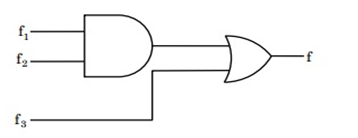
A
∑(4,6)
B
∑(4,8)
C
∑(6,8)
D
∑(4,6,8)
Question 92
+8-2
Consider 4-bit gray code representation of
number. Let h3h2h1h0 be the gray code
representation of number n and g3g2g1g0 be the
gray code representation of the number (n+1)
modulo 16. Which one of the following functions is
correct ?
A
g0(h3h2h1h0)=∑(1,2,3,6,10,13,14,15)
B
g1(h3h2h1h0)=∑(4,9,10,11,12,13,14,15)
C
g2(h3h2h1h0)=∑(2,4,5,6,7,12,13,15)
D
g3(h3h2h1h0)=∑(0,1,6,7,10,11,12,13)
Question 93
+8-2
The minimum number of NAND gates required to
Relize AB+AB'C+AB'C' is
A
3
B
2
C
1
D
0
Question 94
+8-2
Which of the following is equivalent to the
expression (X+Y+Z)
A
(X+Y)Z
B
(X+Y)Z
C
(X+Y)Z
D
(X+Y)Z
Question 95
+8-2
P is a 16 bit signed integer. The 2's complement
representation of P is (F87B)16. The 2's complement
representation of 8*P is
A
(C3D8)16
B
(187B)16
C
(F878)16
D
(987B)16
Question 96
+8-2
which optical phenomenon is utilized in the
operation of the latest write once optical storage
medium called digital paper ?
A
polarization
B
Interference
C
Internal reflection
D
Diffraction
Question 97
+8-2
The number of boolean functions possible with `N' binary variable is equal to:
A
22N
B
2N
C
22N−1
D
2N−1
Question 98
+8-2
When the value of 37H is divided by 17H , the remainder is :
A
C0H
B
03H
C
07H
D
09H
Question 99
+8-2
The minimum number of MOS transistors required to make dynamic RAM cell is :
A
1
B
2
C
3
D
4
Question 100
+8-2
{p→q∨r,q→s,r→s}is logically equivalent
A
q→r
B
r→q
C
p→s
D
s→p
Question 101
+4-1
Which of the following sentence grammatically incorrect ?
A
He is smiling
B
He smiles
C
He always smiles
D
he is always smiling.
Question 102
+4-1
Identify appropriate word to fill the blank in the sentence.''the feeling of guilt left a ……….. impression in the life .''
A
Perennial
B
perennial
C
perennial
D
perinial
Question 103
+4-1
Choose the right word to fill in the blank in the sentence .
`` the marmaid legend …… have originated with group of mammals collectively know to science as srinians''.
A
Should
B
may
C
need
D
can
Question 104
+4-1
Insert appropriate prepositions in the blanks
Tocomplete the sentence . `` this property has been …… the possession … the royal family….. generations.''
A
With ,of, of
B
in ,of for
C
In, with,, by
D
of , by, since
Question 105
+4-1
Identify the type of error in the sentence : `` the cost of this project will be much lesser than 5% more than that predicted earlier .''
A
Syntactical error
B
punctuation
C
Grammatical error
D
conflicting error
Question 106
+4-1
Match the most suitable phrasal verb from group L to each word in group M
Group L Group M
Call out (P) A Foot baler
Stand in for (Q) A criminal
Send down (R) A colleague
Send off (S) A Doctor
A
3-R, 2-S, 1-P, 4-Q
B
1-S, 2-R, 3-Q, 4-P
C
1-P, 2-Q, 3-R,4-S
D
2-P, 3-S, 4-R, 1-Q
Question 107
+4-1
Which of the following sentence is grammatically incorrect ?
A
She never travelled abroad for fear of becoming ill through eating foreign food.
B
She avoids foreign travel as she fears she will become ill through eating foreign food
C
She never travelled abroad due to her fear of becoming ill through eating foreign food.
D
She never travelled abroad in fear for becoming ill with eating foreign food.
Question 108
+4-1
Fill in the blank from among the choices in the sentence:
A couch potato is a person who ……….
A
Spends a lot of time watching lelevision .
B
Spends money of potatoes.
C
Likes potatoes.
D
Is lazy, but intelligent.
Question 109
+4-1
Find the most suitable phrasal verb to be filled in the blank in the following sentence :
`` left too long in the sun, the leaves had all …''
A
Shrugged off
B
shared out
C
Shriveled up
D
skived off
Question 110
+4-1
In the sentence `` the defence labs have showcased many new innovations this year, there is an error of :
A
Redundancy
B
word order
C
Collocation
D
omission
Question 111
+4-1
Which of the following propositions fills up the bland in the the sentence ?
``quinine is an effective antidote …… malaria.''
A
To
B
Against
C
For
D
NOT
Question 112
+4-1
Which of the following is the antonym of the word ``Exigency''
A
Penchant
B
Emergency
C
Earnestness
D
indifference.
Question 113
+4-1
Rearrange the parts of a sentence referred to by P, Q, R and S to form a complete and meaningful sentence : `` I enclose ……………….''
P: and the postage
Q: a postal order
R: the price of books
S: which will cover'
A
RPSQ
B
QSPR
C
QSRP
D
QPSR
Question 114
+4-1
Select the word that is furthest in meaning to the word AFFLUENCE.
A
Stagnation
B
Misery
C
Neglect
D
Poverty
Question 115
+4-1
Replace the underlined word with one of the choices given without changing the meaning of the sentence.
`` the news of our success was met with exuberant cries.''
A
Excited
B
Patheetic
C
Exclusive
D
poignant
Question 116
+4-1
Which of the following terms refers to the original in habitants of place?
A
Originals
B
aborigines
C
Abominables
D
cannibals
Question 117
+4-1
Choose the one which best expresses the following
Sentence in passive /active voice :
`` you can play with these kittens quite safely''
A
These kittens can be played with quite safely.
B
These kittens can played with you quite safely.
C
These kittens can be played with quite safely.
D
These kittens can played with quite safely.
Question 118
+4-1
The proud warrior class of the samurai ( meaning those who serve ) grew from a band of mercenaries hired by feudal landowners in the 11th century to win them the control of Honshu, japan's main island .these mercenaries lived by the cult of the sword, worshipping, atheletic prowess and material skills. They developed a fierce loyalty to their masters and a fearlessness that made them formidable adversaries. They fought in elaborate armour, wielding their most prized possession, a double -edgedsabre with which they could cut a man in half.
Later the Spartan principles of zen buddism ,with it lobe of mature softened their fighting zeal. It became fashionable for them to live sparce and frugal lives during the kamakura era (1192-1333), when the ruling warrior family minamto moved their seat of power to the eastern city of kamakura.
Question: In the kamakura period if become fashionable for these warriors to live :
A
Zealous lives
B
Austere lives
C
Powerful lives
D
natural lives
Question 119
+4-1
The proud warrior class of the samurai ( meaning those who serve ) grew from a band of mercenaries hired by feudal landowners in the 11th century to win them the control of Honshu, japan's main island .these mercenaries lived by the cult of the sword, worshipping, atheletic prowess and material skills. They developed a fierce loyalty to their masters and a fearlessness that made them formidable adversaries. They fought in elaborate armour, wielding their most prized possession, a double -edgedsabre with which they could cut a man in half.
Later the Spartan principles of zen buddism ,with it lobe of mature softened their fighting zeal. It became fashionable for them to live sparce and frugal lives during the kamakura era (1192-1333), when the ruling warrior family minamto moved their seat of power to the eastern city of kamakura.
Question:Which of the following best describes the warriors ?
A
Proud - greedy
B
fearless, worshipful
C
Loyal, fearless
D
possessive ,soft
Question 120
+4-1
The proud warrior class of the samurai ( meaning those who serve ) grew from a band of mercenaries hired by feudal landowners in the 11th century to win them the control of Honshu, japan's main island .these mercenaries lived by the cult of the sword, worshipping, atheletic prowess and material skills. They developed a fierce loyalty to their masters and a fearlessness that made them formidable adversaries. They fought in elaborate armour, wielding their most prized possession, a double -edgedsabre with which they could cut a man in half.
Later the Spartan principles of zen buddism ,with it lobe of mature softened their fighting zeal. It became fashionable for them to live sparce and frugal lives during the kamakura era (1192-1333), when the ruling warrior family minamto moved their seat of power to the eastern city of kamakura.
Question: Who are usually refered to as mercenaries?
A
Soldiers with martial skills .
B
Proud warriors
C
Soldiers who fight for money
D
Loyal warriors
Loading Flux Educare...